
Beach volleyball at the 2012 Summer Olympics – Men's tournament
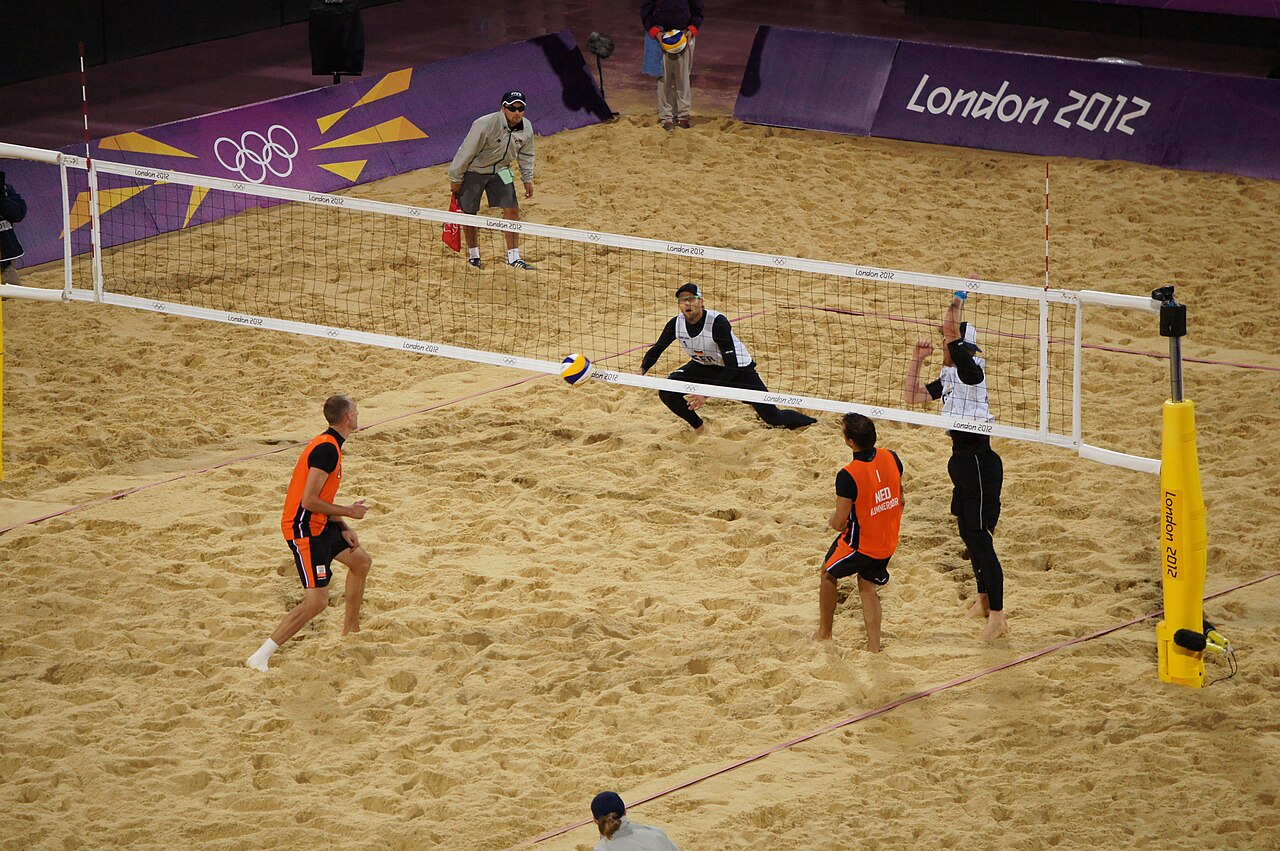
Men's beach volleyball at the 2012 London Olympics.

Wikipedia / Wikimedia Commons
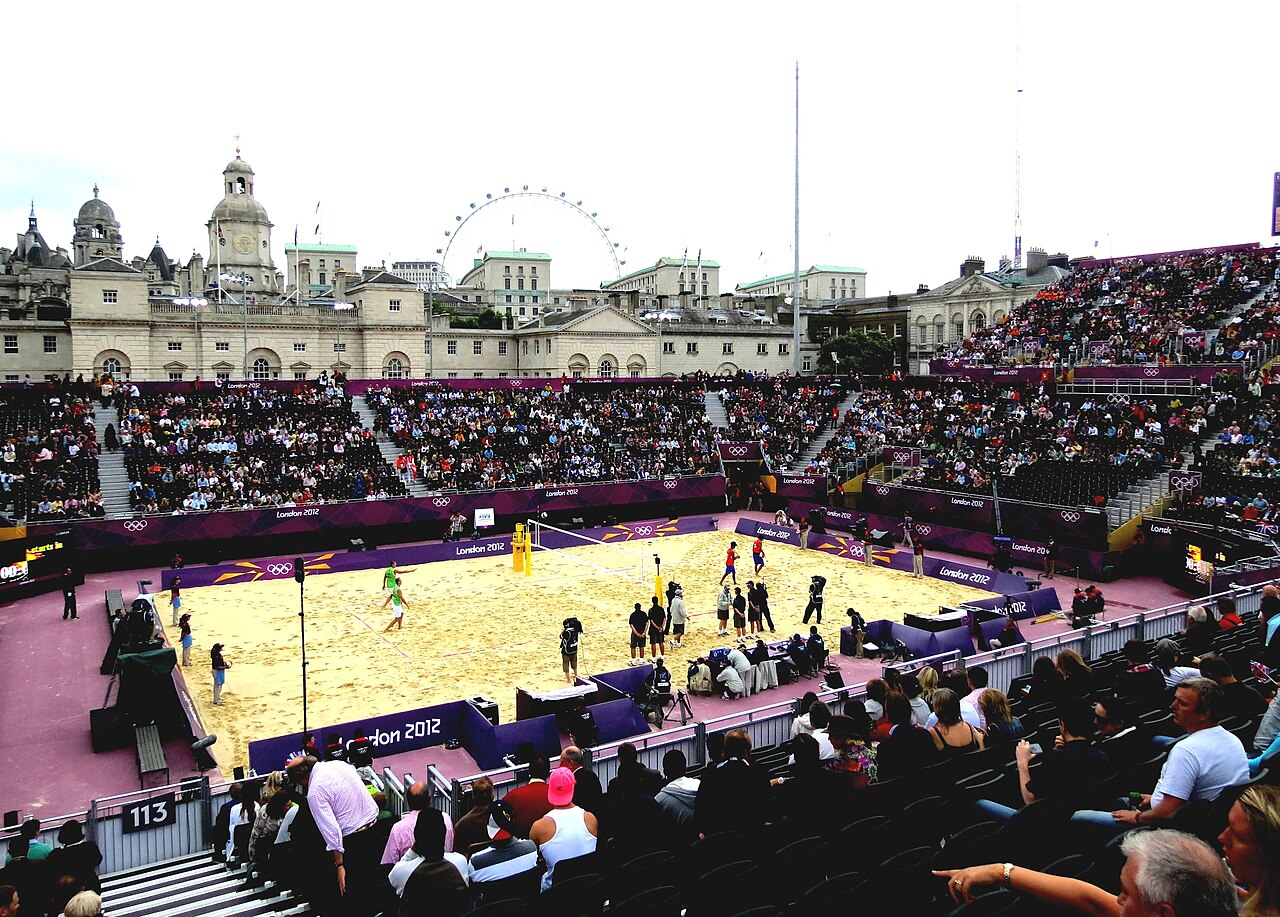
The men's beach volleyball competition at the 2012 Summer Olympics in London was held from 28 July to 9 August at Horse Guards Parade. A total of 24 pairs participated, with Great Britain guaranteed one spot as the host nation and no country allowed more than two teams. Sixteen teams qualified based on their positions in the FIVB World Rankings as of 17 June 2012, five more earned entry through the 2010–12 Continental Cup, and the final three secured their places at the FIVB World Cup Olympic Qualification tournament.
The draw for the preliminary rounds took place on 19 July 2012 in Klagenfurt, Austria. In pool play, a win was worth two points and a loss one point. If two teams were tied, the head-to-head result decided the tie. If three or more teams were tied, the order was determined first by points ratio among the tied teams, then by points ratio within the entire pool, and finally by tournament seed. The top two teams from each pool advanced directly to the round of 16, along with the two best third-place teams. The remaining four third-place teams faced off in Lucky Loser matches, with the two winners completing the 16-team playoff bracket. All match times were given in British Summer Time (UTC+01:00).
- Event
- Men's beach volleyball tournament
- Games
- 2012 Summer Olympics
- Location
- Horse Guards Parade, London, United Kingdom
- Dates
- 28 July – 9 August
- Teams
- 24 pairs
- Qualification
- 16 via FIVB World Rankings, 5 via Continental Cup, 3 via World Cup Olympic Qualification
Lore & Background
The tournament featured 24 pairs, with qualification determined by the FIVB Beach Volleyball World Rankings as of 17 June 2012, the 2010–12 Continental Beach Volleyball Cup, and the FIVB Beach Volleyball World Cup Olympic Qualification tournament. The preliminary round draw was held on 19 July 2012 in Klagenfurt, Austria. Teams earned two points for a win and one for a loss, with tiebreakers including head-to-head results, points ratio, and tournament seed.
Reader's Guide
The tournament structure included six pools, with the two best teams from each group advancing directly to the round of 16. The two best third-placed teams also advanced, while the remaining four third-placed teams competed in Lucky Loser matches to fill the final two playoff spots. All times were British Summer Time (UTC+01:00). The event was part of the broader beach volleyball program at the 2012 Summer Olympics.
Did You Know?
- The tournament took place at Horse Guards Parade in London.
- Twenty-four pairs competed, with a maximum of two per nation.
- The preliminary round draw was held in Klagenfurt, Austria on 19 July 2012.
- Sixteen teams qualified via the FIVB World Rankings as of 17 June 2012.
Tournament Architecture & the Road to the Podium
The 2012 London Olympic volleyball competition for women marked the thirteenth time this event featured in the Games. The FIVB, working alongside the IOC, structured the tournament around twelve qualified nations split into two groups of six. Seeding followed a serpentine method based on world rankings locked in as of mid-January 2012, ensuring a balanced distribution of stronger and weaker sides across both pools. The preliminary phase was a straightforward round-robin: every team in a group faced every other team once. From those ten matches per pool, the four sides with the highest point totals earned passage to the single-elimination knockout stage, where quarterfinals, semifinals, a bronze-medal contest, and the gold-medal final determined the ultimate podium. The entire competition unfolded over roughly two weeks, from late July through early August, giving fans a sustained fortnight of high-stakes indoor volleyball.
Qualification Pathways & the Combined Asian-World Format
The road to London in 2012 featured a particularly streamlined qualification structure for Asian and global contenders. Rather than holding separate events, the FIVB merged the Asian Qualification Tournament with the World Qualification Tournament into a single combined competition. The top three finishing teams in that combined event claimed their spots as the winners of the World Qualification Tournament. Meanwhile, the highest-ranked Asian team that finished outside those top three positions secured the dedicated Asian Qualification slot. This dual-purpose format meant that a single tournament simultaneously served two qualification pathways, creating an extra layer of strategic tension for Asian teams who needed to balance their pursuit of a top-three global finish against the safety net of the continental berth. The system ensured that both global competitiveness and continental representation were addressed within one competitive window, reducing the logistical burden on participating nations while preserving the FIVB's commitment to geographic diversity in the Olympic field.
Scoring Mechanics & the Tiebreaker Ladder
The preliminary round employed a graduated points system that rewarded both dominance and resilience. A clean 3–0 or 3–1 victory earned the winning side three points, while a hard-fought 3–2 triumph yielded two. Notably, even a 3–2 loss was not without reward: the defeated team still collected one point for pushing the match to a decisive fifth set. A 3–0 or 3–1 defeat, by contrast, left the losing side with nothing. When pool play concluded with teams level on points, a four-step tiebreaker hierarchy resolved the deadlock: first, the greater number of match wins; second, the superior set-win ratio; third, the overall points ratio; and fourth, the head-to-head result between the tied sides. A special provision applied when three or more teams were level—tiebreakers were calculated exclusively among the matches those tied teams played against one another, isolating their direct encounters from the rest of the pool schedule.
Venue, Timing & Individual Recognition
The 2012 Olympic women's volleyball tournament found its home at the Earls Court Exhibition Centre in London, a venue that hosted the competition from 28 July through 11 August 2012. All match times were listed in British Summer Time, reflecting the tournament's placement squarely within the summer Olympic window. The event carried the weight of tradition as the thirteenth edition of women's volleyball to appear at the Olympic Games, underscoring the sport's long-standing place in the international program. At the individual level, the tournament's most coveted personal honour went to South Korea's Kim Yeon-koung, who was named the Most Valuable Player of the competition. Statistical leaderboards tracked the performances of players whose teams reached the quarterfinal stage, ensuring that the data reflected only those athletes who had progressed deep enough into the tournament to be considered for individual recognition. The combination of a historic venue, a fortnight-long schedule, and standout individual performances gave the 2012 edition a distinct identity within the broader Olympic volleyball narrative.
Gallery
Frequently Asked Questions
Where and when was the men's beach volleyball tournament held at the 2012 London Olympics?
The competition ran from 28 July to 9 August at Horse Guards Parade, a ceremonial ground in central London rather than a traditional sports stadium. This made it one of the few Olympic events staged in the heart of the capital city.
How many pairs competed and how did they qualify for the 2012 men's beach volleyball event?
Twenty-four pairs took the court, with sixteen slots filled by FIVB world rankings as of 17 June 2012, five earned through the 2010–12 Continental Cup cycle, and three decided at a dedicated Olympic qualifying tournament. Great Britain received an automatic entry as host, and no nation was permitted to send more than two pairs.
Who won the gold medal in men's beach volleyball at the 2012 Summer Olympics?
Brazilian partners Alison Cerutti and Emanuel Rego took the gold, cementing Brazil's reputation as the powerhouse nation in Olympic beach volleyball. Their victory continued a streak of Brazilian dominance in the men's event that had spanned multiple Games.
What was special about the Horse Guards Parade venue for the 2012 beach volleyball competition?
The historic parade ground in Westminster was repurposed to host an Olympic sport, placing the action within walking distance of Parliament and the City of London. It gave spectators a unique urban backdrop that no other Olympic beach volleyball venue had offered.
When and where was the preliminary round draw for the 2012 men's beach volleyball tournament conducted?
The draw took place on 19 July 2012 in Klagenfurt, Austria, roughly a week before the first match was played in London. The resulting group assignments set up a bracket that fans followed across the twelve-day competition.
More in Beach volleyball at the Summer Olympics 1-19
Spotted an error? Know more?
This is a living reference — every entry is fact-audited, and reader corrections feed straight into our audit queue. Suggest an edit · See this site's audit record