
Beach volleyball at the 2008 Summer Olympics – Women's tournament
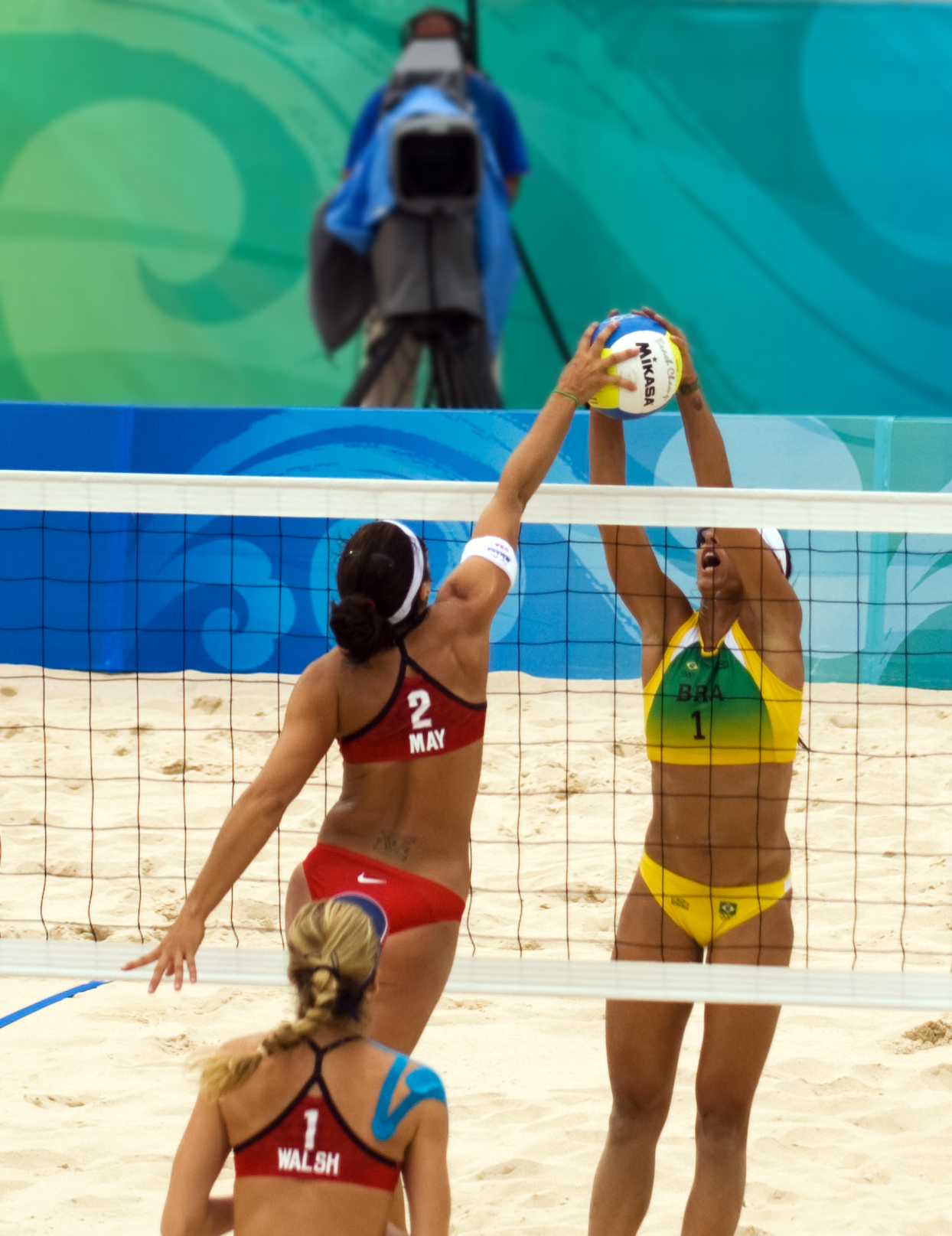
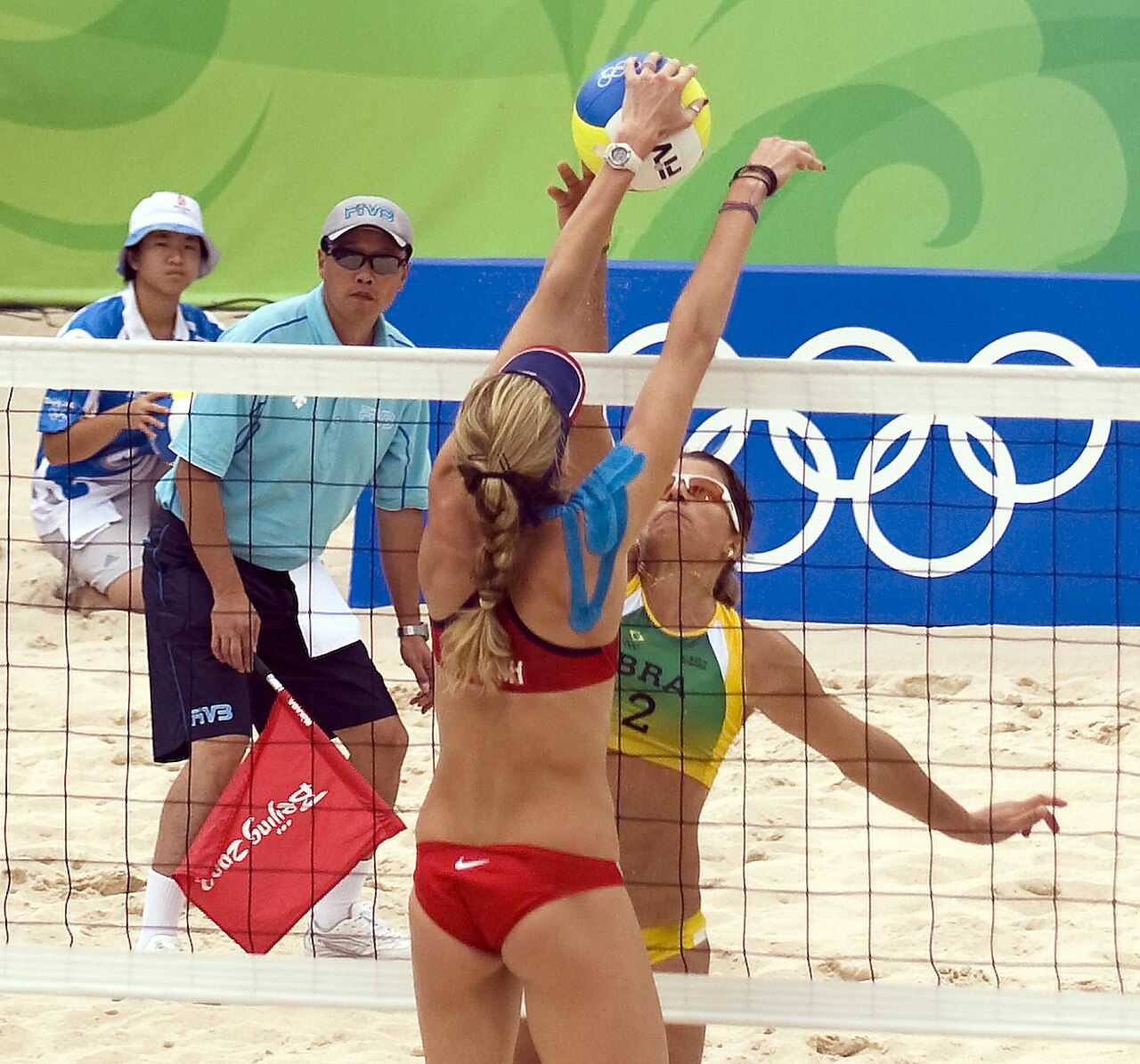
24 pairs competed in Beijing from August 9–21, 2008.

Wikipedia / Wikimedia Commons
The women's beach volleyball competition at the 2008 Beijing Olympics ran from August 9 to August 21 at the Chaoyang Park Beach Volleyball Ground. Twenty-four pairs entered, with each country limited to two teams. Qualification was determined by a team's eight best results between January 1, 2007, and July 20, 2008, on the Swatch FIVB World Tour, the 2007 FIVB World Championships, and FIVB-recognized Continental Championship Finals.
The 24 teams were split into six groups of four. Each group played a round-robin, with the top two from each pool advancing to the Round of 16. The six third-place teams were ranked by their points-won-to-points-lost ratio; the best two advanced directly, while the remaining four played two "lucky loser" matches (third vs. sixth, fourth vs. fifth). The winners of those matches also advanced, while the losers and all fourth-place teams were eliminated. The 16 teams then competed in a single-elimination bracket, with a bronze medal match for the semifinal losers.
Because the host nation had a team in the top six of the FIVB Olympic ranking, China's Tian Jia and Wang (ranked second) were automatically seeded first and placed in Pool A. The seeding draw for positions 7–9, 10–12, 13–18, and 19–24 was held on July 26 in Gstaad during the 1 to 1 Energy Grand Slam. The official qualification cutoff was July 20, 2008, with the final ranking confirmed on July 24. The United States had four teams in the top eight of that ranking, Brazil had seven in the top 24, China had three, and Germany had four—but only two per country could compete. Two substitutions occurred: Brazil's Juliana Felisberta was replaced by Ana Paula Connelly due to injury, and Austria's Montagnolli–Swoboda was replaced by Switzerland's Kuhn–Schwer for medical reasons.
After pool play, the United States, Brazil, and China each had two teams advance to the Round of 16, and all six won their matches to reach the quarterfinals. Austria and Australia also won their Round of 16 matches to claim the remaining quarterfinal spots. During the women's playoff on August 15, a spectator gave birth to a boy in the stadium bathroom; medical workers were alerted at 10:10 a.m. and arrived four minutes later to find the baby already delivered. The gold medal match and award ceremony took place on August 21 at 12:10 p.m.
- Event
- Women's beach volleyball tournament
- Games
- 2008 Summer Olympics
- Location
- Beach Volleyball Ground, Chaoyang Park, Beijing
- Dates
- August 9–21, 2008
- Teams
- 24 pairs
- Qualification cutoff
- July 20, 2008
- Final ranking announced
- July 24, 2008
Lore & Background
The tournament began with a preliminary round in which each of the 24 pairs was placed into one of six groups of four teams. Within each group, teams played a round-robin; the top two teams from each pool advanced to the Round of 16. The six third-place teams were ranked against each other by the ratio of points won to points lost, with the best two advancing directly. The remaining four third-place teams played two lucky loser matches (#3 vs. #6 and #4 vs. #5), with the winners advancing and the losers eliminated. All fourth-place teams were also eliminated.
The 16 teams that advanced then competed in a single-elimination tournament, including a bronze medal match between the semifinal losers. The United States, Brazil, and China each directly qualified two teams for the Round of 16, and all six won their Round of 16 matches to reach the quarterfinals. Austria and Australia also won their Round of 16 matches to take the remaining two quarterfinal spots.
Notably, on August 15, a spectator gave birth to a baby boy in the bathroom of the Olympic beach volleyball stadium during the women's playoff. Medical workers received the message at 10:10 a.m., and the baby was already born when they arrived four minutes later.
Reader's Guide
The 2008 women's beach volleyball tournament was significant for its qualification and seeding rules. The host nation, China, had its team Tian Jia – Wang automatically seeded as #1, even though they were ranked #2 on the FIVB Olympic ranking, because the host nation's top-6 team is moved to the top seed. The tournament also featured a unique lucky loser system for third-place teams, using point ratios to determine direct advancement and then holding two elimination matches among the remaining third-place teams. This format ensured that 16 of the 24 teams advanced to the knockout stage. The event highlighted the dominance of the United States, Brazil, and China, as all six of their teams reached the quarterfinals. The tournament also saw a replacement: Brazil's Juliana Felisberta was replaced by Ana Paula Connelly due to injury, and the Austrian team Montagnolli – Swoboda was replaced by the Swiss team Kuhn – Schwer for medical reasons. The competition took place at a dedicated venue in Chaoyang Park, with the gold medal match and award ceremony held on August 21 at 12:10.
Did You Know?
- The host nation's team, if in the top 6 of the FIVB Olympic ranking, is automatically seeded as #1; China's Tian Jia – Wang, ranked #2, was thus placed in Pool A.
- On August 15, a spectator gave birth to a baby boy in the bathroom of the Olympic beach volleyball stadium; the baby was already born when medical workers arrived four minutes after the call at 10:10 a.m.
- Brazil's Juliana Felisberta was replaced by Ana Paula Connelly due to injury, and Austria's Montagnolli – Swoboda was replaced by Switzerland's Kuhn – Schwer for medical reasons.
- The two best third-place teams from the pool stage advanced directly to the Round of 16, while the other four third-place teams played lucky loser matches to determine two more spots.
Tournament Architecture and Olympic Lineage
The women's volleyball competition at the 2012 London Games represented the thirteenth time the event had appeared on the Olympic programme, a milestone that underscored the sport's deepening integration into the Games. The FIVB, acting as the international governing body, partnered with the IOC to deliver the tournament, which took place at the Earls Court Exhibition Centre over a two-week span from late July through early August. Twelve nations earned their places on the court, and they were distributed into two pools of six using a serpentine seeding method based on world rankings frozen on 15 January 2012. Each pool followed a round-robin format before the four highest-ranked teams from each group progressed into a single-elimination knockout bracket that ultimately determined the gold, silver, and bronze medalists. This hybrid structure—pool play followed by elimination—balanced the need for every team to accumulate meaningful matches against the drama of decisive knockout contests.
Qualification: A Dual-Pathway System for Asia
One of the more distinctive features of the 2012 qualification cycle was how the FIVB wove together two continental and global pathways into a single combined event. The Asian Qualification Tournament was merged with the World Qualification Tournament, creating a unified competition in which teams from across the globe competed for the same limited set of Olympic berths. The three highest-finishing teams overall claimed their spots as the winners of the World Qualification Tournament. Separately, the best-placed Asian team that did not finish in the top three secured an additional berth specifically as the Asian Qualification Tournament winner. This dual designation ensured that even if Asian teams were outperformed by non-Asian opponents in the overall standings, the continent still guaranteed representation at the Games. The arrangement reflected the FIVB's effort to balance global competitiveness with regional equity, giving smaller Asian programmes a realistic route to London while preserving the integrity of a worldwide qualifier.
Scoring Mechanics and Tiebreaker Logic
The pool stage employed a nuanced points system designed to reward both dominant victories and hard-fought five-set battles. A team sweeping a match 3–0 or winning 3–1 collected three points, while a 3–2 triumph earned two. Even a loss in five sets was not without reward: the defeated side still banked a single point, whereas a 3–0 or 3–1 defeat yielded nothing. This graduated structure meant that a team stringing together narrow five-set wins could accumulate comparable points to one posting more decisive victories, adding a strategic layer to match management. When pools concluded with tied point totals, a four-tier tiebreaker sequence resolved the deadlock: first by number of wins, then by set win ratio, followed by points ratio, and finally by head-to-head results. Crucially, if three or more teams were level, those tiebreakers were applied exclusively to the matches played among the tied sides, preventing outside results from distorting the outcome.
Individual Spotlight: Kim Yeon-koung and the Awards Framework
Beyond the collective pursuit of medals, the 2012 tournament featured a structured system of individual recognition that highlighted standout performers. The Most Valuable Player award went to South Korea's Kim Yeon-koung, a designation that placed her at the apex of the competition's individual rankings. The FIVB also compiled statistics leader boards, though with an important caveat: only players whose teams advanced as far as the quarterfinals were eligible for those rankings, ensuring that the statistical honours reflected athletes who had sustained performance through the deeper stages of the tournament. This eligibility threshold meant that the numbers told a story of consistency under pressure rather than a single brilliant pool-stage outing. Together, the MVP title, the statistical leaderboards, and the official medalist listings formed a layered recognition framework that celebrated both the team's journey and the individual contributions that powered it forward.
Gallery

Frequently Asked Questions
What was the women's beach volleyball event at the 2008 Summer Olympics?
It was the Olympic medal competition for women's beach volleyball, pitting 24 pairs of athletes against one another for gold, silver, and bronze at the Beijing Games.
Where and when did the 2008 Olympic women's beach volleyball tournament take place?
All matches were played at the Beach Volleyball Ground in Chaoyang Park, Beijing, with competition running from August 9 through August 21, 2008.
How did teams earn a spot in the 2008 Beijing women's beach volleyball competition?
Qualification was based on each pair's eight best results across the Swatch FIVB World Tour, the 2007 FIVB World Championships, and FIVB-recognized Continental Championship Finals, with a cutoff date of July 20, 2008.
How was the 2008 Olympic women's beach volleyball bracket structured?
The 24 pairs were divided into six groups of four for a round-robin stage, and the top two teams from each pool advanced to the Round of 16.
How many teams could each country send to the 2008 women's beach volleyball event?
Each nation was capped at a maximum of two pairs, which kept the overall field at exactly 24 competing teams.
More in Beach volleyball at the Summer Olympics 1-19
Spotted an error? Know more?
This is a living reference — every entry is fact-audited, and reader corrections feed straight into our audit queue. Suggest an edit · See this site's audit record