
Beach volleyball at the 2004 Summer Olympics – Women's tournament
Walsh and May won gold without losing a set.

Wikipedia / Wikimedia Commons
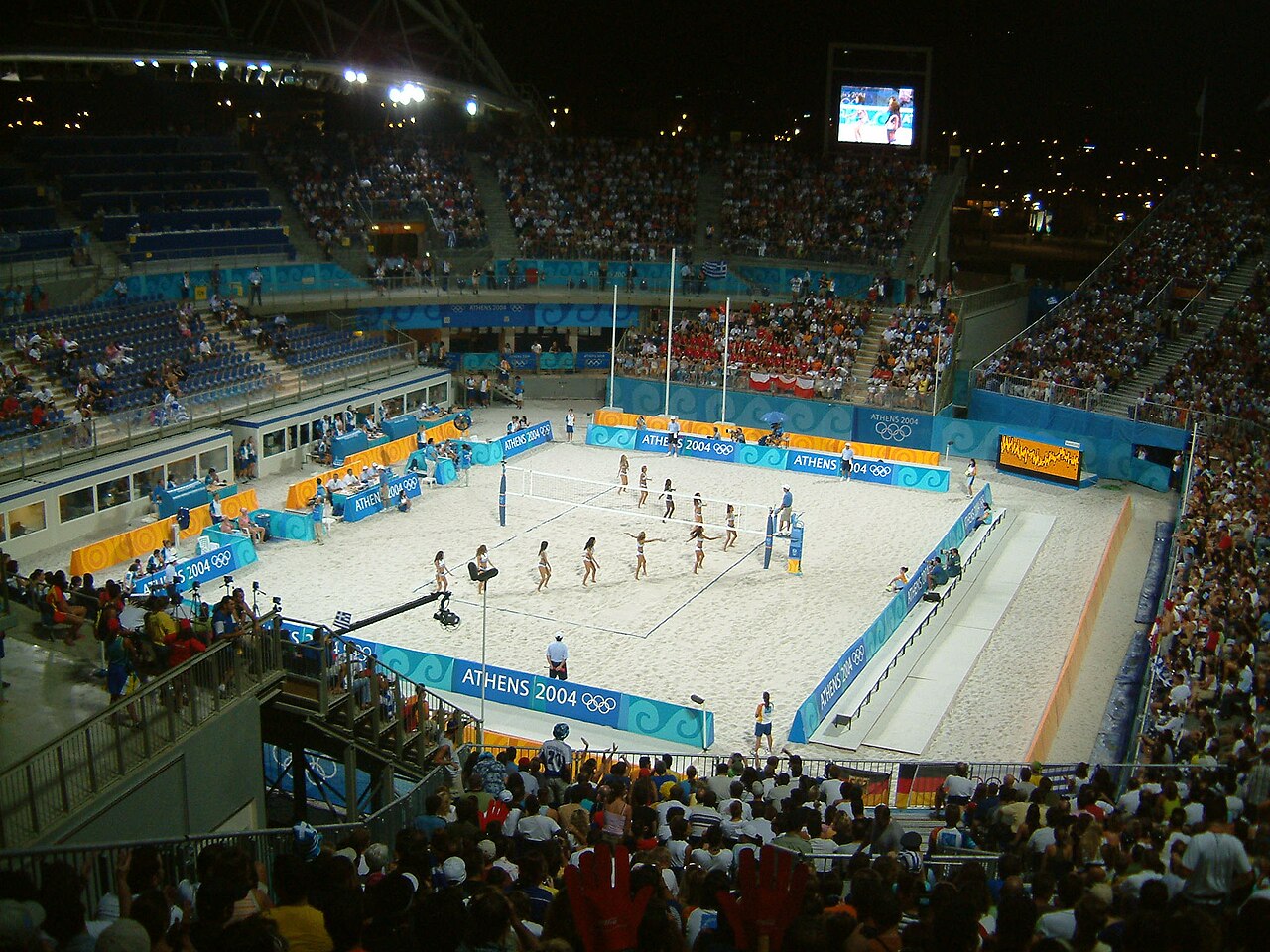
The women's beach volleyball competition at the 2004 Summer Olympics took place at the Olympic Beach Volleyball Centre, part of the Faliro Coastal Zone Olympic Complex in Athens, Greece. Kerri Walsh and Misty May claimed the gold medal, achieving a flawless tournament without dropping a single set. The defending champions from the 2000 Games, Natalie Cook and Kerri Ann Pottharst, competed with different partners in Athens; they met in the round of sixteen, where Cook’s team won. Adriana Behar and Shelda Bede earned the silver medal, matching their result from the 2000 Olympics.
In the pool stage, 24 teams were divided into six pools of four. Each team played the other three in its pool in best-of-three-set matches. Teams were ranked within each pool by matches won. Two-way ties were broken by the head-to-head result; three-way ties were resolved by calculating the total points for and against among the tied teams, with the lowest-ranked team eliminated by points ratio, and the remaining two ranked by head-to-head. The top two teams from each pool, along with the four best third-place teams (selected first by wins, then set ratio, then points ratio), advanced to a single-elimination round of sixteen. Two points were awarded for a win, one for a loss. In match tables, winners are shown in bold, and advancing teams are highlighted.
Pool A matches were played on August 15, 17, and 19. Pool B on the same dates. Pool C also on August 15, 17, and 19. Pool D matches took place on August 14, 16, and 18. Pool E on August 14, 16, and 18. Pool F on August 14, 16, and 18.
The round of 16 was held on August 20 and 21. Quarter-finals were on August 22. Semi-finals on August 23. The bronze-medal match and gold-medal match both took place on August 24.
- Event
- Women's beach volleyball
- Location
- Olympic Beach Volleyball Centre, Faliro Coastal Zone Olympic Complex, Athens, Greece
- Gold medalists
- Kerri Walsh and Misty May (USA)
- Silver medalists
- Adriana Behar and Shelda Bede (Brazil)
- Reigning champions
- Natalie Cook and Kerri Ann Pottharst (Australia)
- Number of teams
- 24
- Format
- Pool play followed by single-elimination round of 16
Lore & Background
The tournament featured 24 teams split into six pools of four. Each team played three pool matches, with the top two from each pool and the four best third-placed teams advancing to the round of 16. Points were awarded two for a win and one for a loss. Tie-breaking procedures included head-to-head results and point ratios.
Reader's Guide
The 2004 women's beach volleyball tournament is notable for the dominant performance of Kerri Walsh and Misty May, who won every match without dropping a set. The silver medalists, Adriana Behar and Shelda Bede of Brazil, repeated their result from the 2000 Olympics. The reigning champions from 2000, Natalie Cook and Kerri Ann Pottharst, competed with new partners and met in the round of 16, where Cook's team won. The event was held at a purpose-built venue in the Faliro Coastal Zone Olympic Complex.
Did You Know?
- Kerri Walsh and Misty May had a perfect record, losing not a single set in the tournament.
- Adriana Behar and Shelda Bede repeated their 2000 Olympic result, taking silver.
- The reigning champions from 2000, Natalie Cook and Kerri Ann Pottharst, both had new partners for Athens and met in the round of 16, where Cook's team won.
- The tournament was held at the Olympic Beach Volleyball Centre at the Faliro Coastal Zone Olympic Complex.
The Birth and Evolution of the Olympic Format
Volleyball's path to the Olympic stage began long before its official debut. In 1924, the sport appeared as an unofficial demonstration event in Paris, but it was only after World War II, with the establishment of the FIVB and continental confederations, that a serious push for inclusion gained momentum. A showcase tournament held during the 53rd IOC session in Sofia, Bulgaria, in 1957 proved the sport's broad appeal, and volleyball was formally added to the program for the 1964 Games. The IOC even attempted to remove it for 1968, but widespread protest forced them to retain it. The early competition mirrored the World Cup structure: every nation played every other, with rankings decided by wins, set average, and point average. This round-robin approach carried a notable flaw—medal outcomes could be locked in before the final matches, draining spectator engagement. The solution arrived in 1972, when a two-phase structure was introduced, adding quarterfinals, semifinals, and a championship match. This so-called Olympic format has remained the standard ever since. The field has also expanded steadily, and since 1996, both men's and women's indoor events feature twelve nations, with at least one federation from each of the five continental confederations represented.
Brazil's 2004 Crown and the Men's Gold Landscape
The 2004 Athens final saw Brazil defeat Italy to secure their second Olympic gold, a result that solidified their status as the preeminent men's volleyball nation of the 2000s. Their path to glory echoed the 1992 Barcelona upset, when they overcame the Unified Team, the Netherlands, and Italy to claim their first title. By 2016, competing on home soil, Brazil added a third gold with a straight-set win over Italy once again. Italy's Olympic story, by contrast, is one of persistent near-misses. Despite never missing a tournament since 1976 and consistently reaching the medal rounds, they remain the only recognized volleyball powerhouse without a single Olympic gold. Their 2004 final defeat was part of a longer streak of heartbreak: bronze in Atlanta 1996, a 2008 bronze-medal loss to Russia, and a 2016 final loss to the Brazilians. The men's gold medal distribution reflects a broader pattern of relative diversity—only the former Soviet Union, the United States, Brazil, and France have won more than once, while six other nations each claimed a single title across the tournament's history.
A Tale of Two Podiums: Men's and Women's Medal Distribution
The distribution of Olympic volleyball golds reveals a striking contrast between the men's and women's competitions. In the men's tournament, ten editions have been won by ten different nations, with only four—Brazil, France, the United States, and the former Soviet Union—managing to lift the trophy more than once. The remaining six titles went to Japan, Poland, the Netherlands, Russia, and the defunct Yugoslavia, each claiming a single victory. The women's picture is markedly more concentrated. Across sixteen editions, only seven countries have stood atop the podium: Brazil, Cuba, China, Japan, Italy, the United States, and the former Soviet Union. This means the women's gold is considerably harder to share among the global field. Japan, as host nation, claimed the inaugural women's title in 1964, followed by back-to-back Soviet victories in 1968 and 1972. The 1980 American-led boycott had a more pronounced effect on the women's competition than the men's, largely because the strongest men's squads were already concentrated in the Eastern Bloc, making the absence of Western teams less disruptive to that particular field.
Cold War Rivalries on the Volleyball Court
The Olympic volleyball tournament has long served as a proxy for geopolitical tensions. The 1980 Moscow Games, boycotted by the United States and several Western nations, saw the Soviet Union collect their third gold with a 3–1 victory over Bulgaria. The absence of American and other Western teams had a smaller impact on the men's event than on the women's, because the strongest men's squads were already concentrated in the Eastern Bloc. Four years later, the Soviet-led boycott of Los Angeles 1984 reshaped the landscape. The United States, now the undisputed leader of Western volleyball, swept Brazil in the final to claim their second gold. Italy, a relative newcomer to the sport's elite tier, earned their first Olympic medal that year—a bronze that foreshadowed their rise as a major force in later decades. The long-awaited showdown between the two volleyball superpowers finally arrived in Seoul 1988, where power players Karch Kiraly and Steve Timmons anchored the American attack to a second gold. Political echoes continued into the 2000s, with Yugoslavia competing under the name Federal Republic of Yugoslavia in 1996 and 2000, and in 2000, Serbia and Montenegro—led by the Grbić twins—defeated Russia for the gold.
Gallery
Frequently Asked Questions
Who won the women's beach volleyball gold medal at the 2004 Athens Olympics?
American duo Kerri Walsh and Misty May took the gold, sweeping every match in the tournament without surrendering a single set.
Where was the women's beach volleyball competition held in Athens 2004?
All matches took place at the Olympic Beach Volleyball Centre, which sits within the Faliro Coastal Zone Olympic Complex on the coast of Athens, Greece.
Did the 2000 defending champions repeat in 2004?
No. Natalie Cook and Kerri Ann Pottharst, who had won gold in Sydney, entered Athens with new partners and actually faced each other in the round of sixteen, with Cook's team advancing.
What made Walsh and May's 2004 Olympic run stand out?
They completed the entire bracket without dropping one set, a perfectly clean sweep that made their gold medal especially dominant.
Who finished second in the 2004 women's beach volleyball final?
Brazil's Adriana Behar and Shelda Bede claimed the silver medal, replicating the exact same podium finish they had achieved at the 2000 Sydney Games.
More in Beach volleyball at the Summer Olympics 1-19
Spotted an error? Know more?
This is a living reference — every entry is fact-audited, and reader corrections feed straight into our audit queue. Suggest an edit · See this site's audit record