
Beach volleyball at the 2008 Summer Olympics – Men's tournament
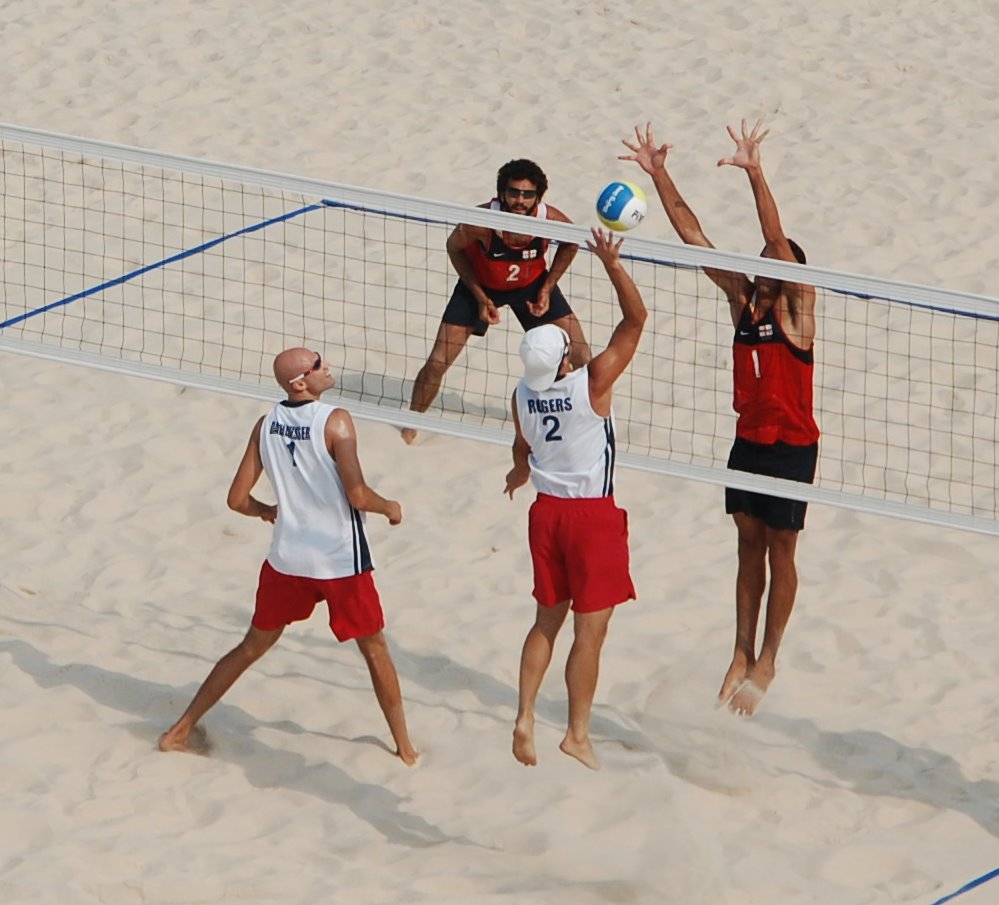
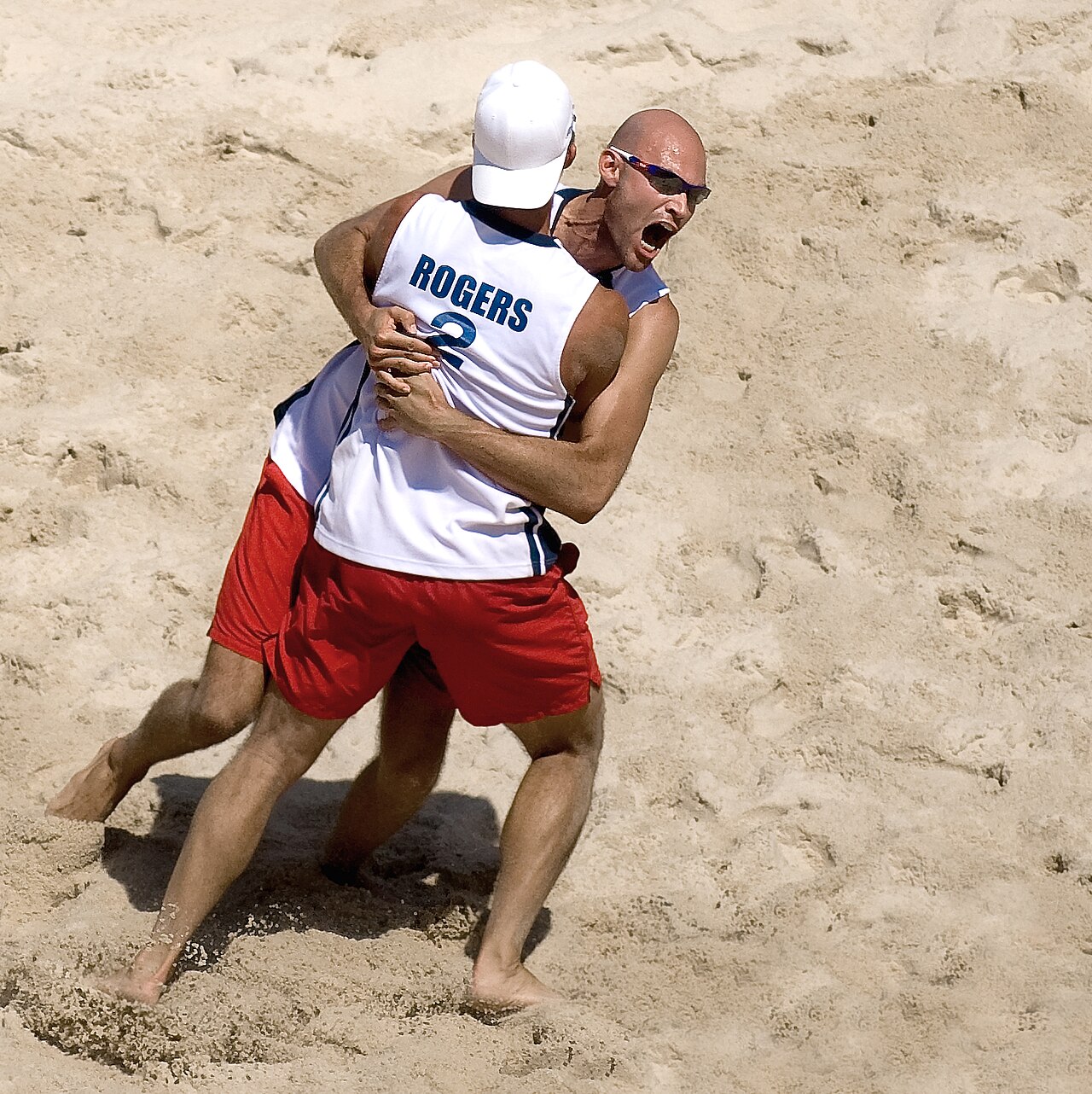
Men's beach volleyball tournament at the 2008 Beijing Olympics.

Wikipedia / Wikimedia Commons
The men's Olympic beach volleyball tournament at the 2008 Summer Olympics in Beijing took place at the Beach Volleyball Ground at Chaoyang Park from August 9 to August 22. Twenty-four pairs competed, with a maximum of two teams per country. The tournament featured a preliminary round of six groups, followed by a single-elimination playoff bracket including a bronze medal match.
- Event
- Men's beach volleyball at the 2008 Summer Olympics
- Location
- Beach Volleyball Ground at Chaoyang Park, Beijing
- Dates
- August 9 to August 22, 2008
- Teams
- 24 pairs (from multiple nations)
- Format
- Group round-robin then single-elimination
- Medal presenters
- Beatrice Allen (IOC, Gambia) and Ruben Acosta (FIVB, Mexico)
Lore & Background
Notable qualification details: the Brazilian team Harley-Pedro was ranked #5 on the Olympic ranking but did not qualify due to the two-teams-per-country rule, despite being #2 on the world ranking as of July 21, 2008, and #1 as of August 4, 2008. Italy replaced Matteo Varnier with Eugenio Amore due to Varnier's injury.
Reader's Guide
The 2008 men's Olympic beach volleyball tournament was significant as the first Olympic beach volleyball event held in China, showcasing the sport's global expansion. The seeding rule favoring the host nation altered the bracket, as China's Xu-Wu became the top seed despite being ranked #5. The qualification system, based on a rolling 18-month period, emphasized consistency on the FIVB World Tour and major championships. The tournament's structure—with group play, Lucky Loser matches, and a single-elimination bracket—balanced fairness and drama. The per-country limit of two teams prevented nations like Brazil, Germany, the USA, and the Netherlands from dominating the field, ensuring broader representation. The medal presentation by IOC and FIVB officials underscored the event's Olympic status. The tournament's legacy includes its role in popularizing beach volleyball in Asia and its demonstration of the sport's competitive depth, as evidenced by the tight qualification race and the displacement of top-ranked teams by host seeding.
Did You Know?
- The host nation China's team Xu-Wu was automatically seeded #1 because they were in the top six of the Olympic ranking, even though they were ranked #5.
- Brazil's Harley-Pedro was ranked #2 on the world ranking as of July 21, 2008, but did not qualify due to the two-teams-per-country rule.
- Italy replaced Matteo Varnier with Eugenio Amore due to Varnier's injury.
- The Lucky Loser matches involved the four lowest-ranked third-place teams, with winners advancing to the Round of 16.
Tournament Format and Competitive Structure
The 2012 London Olympic women's volleyball competition featured a two-stage competitive structure that balanced extended pool play with the intensity of single-elimination matches. Twelve qualified nations were split into two groups of six, with each team facing every other member of its pool in a round-robin schedule. The scoring system rewarded dominant victories more generously: a clean 3–0 or 3–1 sweep earned three points, while a hard-fought 3–2 triumph yielded two. Even a loss could generate a point if the defeated team managed to take one set. Should teams finish pool play level on points, a tiered set of tiebreakers determined advancement—starting with total wins, then set win ratio, followed by points ratio, and finally head-to-head results. When three or more teams were entangled in a tie, those tiebreakers applied exclusively to the matches among the tied sides. The top four finishers in each group earned a place in the knockout bracket, where quarterfinals, semifinals, a bronze medal contest, and the final decided all Olympic medals.
Qualification Pathways and Seeding
Securing a spot in the 2012 Olympic women's volleyball tournament required navigating a carefully designed qualification framework that merged continental and global pathways. The Asian Qualification Tournament was not held as a separate standalone event; instead, it was integrated directly into the broader World Qualification Tournament. This combined structure meant that the three highest-placing teams overall claimed their Olympic berths as the winners of the World Qualification Tournament. However, the system also guaranteed representation from Asia: the best-performing Asian team that did not finish in the overall top three still earned a dedicated Olympic spot as the Asian Qualification Tournament winner. Once all twelve nations had qualified, they were assigned to their pools using the Serpentine seeding method, with placements determined by each team's ranking as of 15 January 2012. This approach ensured that the strongest teams were distributed across both groups, creating a balanced and competitive preliminary stage.
Venue, Timing, and Organizational Framework
The 2012 London Games marked the thirteenth time that women's volleyball had featured on the Olympic programme, a testament to the sport's enduring popularity and institutional support. The tournament was staged at the Earls Court Exhibition Centre, a well-known London venue that provided a dedicated indoor arena for the competition. The event ran from 28 July through 11 August 2012, spanning roughly two weeks of intense competition. Organizational responsibility fell to the Fédération Internationale de Volleyball, the sport's global governing body, working in close partnership with the International Olympic Committee to ensure the tournament met Olympic standards. All match times throughout the competition were listed in British Summer Time, reflecting the tournament's location in the United Kingdom. The combination of a prestigious venue, a two-week schedule, and the backing of both the FIVB and the IOC underscored the significance of this edition within the broader Olympic calendar.
Individual Recognition and Statistical Legacy
Beyond team results, the 2012 Olympic women's volleyball tournament provided a platform for individual excellence to be formally recognized. The Most Valuable Player award, the tournament's highest individual honour, was presented to Kim Yeon-koung of South Korea, acknowledging her outstanding contributions throughout the competition. The official statistics leaders charts offered a detailed look at individual performance metrics, though with an important caveat: only players whose national teams advanced to the quarterfinals were included in the rankings. This restriction ensured that the statistical leaders reflected the caliber of the tournament's upper bracket rather than diluting the data with preliminary-round performances. The final standings table and the medalists' list provided the definitive record of team success, while the individual awards section highlighted the athletes who stood out from their squads. Together, these records captured both the collective and personal dimensions of Olympic volleyball at its highest level.
Gallery

Frequently Asked Questions
Where was the men's beach volleyball tournament played during the 2008 Beijing Olympics?
The competition was staged at the Beach Volleyball Ground located in Chaoyang Park, Beijing. All matches across the event's two-week run took place on that single sand court.
How many pairs entered the 2008 men's Olympic beach volleyball draw?
A total of 24 pairs from various nations competed, with a cap of two teams allowed per country. Those 24 pairs were split into six preliminary groups before advancing to the knockout stage.
What was the tournament format for men's beach volleyball at the 2008 Games?
The event began with a six-group round-robin phase, after which the remaining pairs moved into a single-elimination bracket. A dedicated bronze-medal match was included at the end of the playoff round.
On what dates did the men's beach volleyball competition run at the 2008 Summer Olympics?
Matches were contested from August 9 through August 22, 2008, giving the tournament a full two-week window within the Beijing Games schedule.
Who presented the medals at the men's beach volleyball finals in Beijing 2008?
IOC representative Beatrice Allen from The Gambia and FIVB official Ruben Acosta from Mexico served as the medal presenters for the event.
More in Beach volleyball at the Summer Olympics 1-19
Spotted an error? Know more?
This is a living reference — every entry is fact-audited, and reader corrections feed straight into our audit queue. Suggest an edit · See this site's audit record